# Water Damage Restoration in Greenfield, Pittsburgh
A stream that no longer exists still floods Greenfield. Four Mile Run is buried underground — culverted in the 1800s so a steel mill could build over it — but the low-lying section called "In the Run" floods exactly as the old valley says it should. On September 3, 2026, about 1.6 inches of rain fell in 30 minutes over Hazelwood, Oakland, Squirrel Hill, and Greenfield, and In the Run flooded as predicted. The watershed's main drain, the M-29 outfall — a 450-foot 1892 brick culvert, the system's third-largest combined sewer overflow — can't take what the paved valley now delivers. Immediate Restoration Pennsylvania provides 24/7 water damage restoration in Greenfield: emergency extraction, structural drying, sewage cleanup, and mold remediation for the brick rowhouses, twins, and bungalows at the bottom of the valley.
Water Damage Services in Greenfield
The Stream That Isn't There
Greenfield's cruelest trick is invisibility: there's no creek to watch, just a valley that behaves like one. PWSA's Four Mile Run Stormwater Improvement Project — announced in 2017 as the fix — was supposed to include a daylighted stream through Junction Hollow to the Monongahela. In late 2022 PWSA cut the green-infrastructure elements over permitting fights and CSX negotiations, confining the scope to The Run itself. The buried stream stays buried; the flooding stays too. The Mon Water Project, the advocacy group formed for In the Run's flooding, now sends community flooding surveys after storms like September's — the neighborhood floods on a schedule anyone can predict.
The other Greenfield signature is the pipe under the street. In January 2026, a water line rupture flooded a Greenfield home's garage and basement with two feet of water — 91-year-old Ann Sciulli waited about seven hours while crews worked five valves to stop it; tiles lifted, furniture ruined, and her insurer denied the claim because the water came from outside. In December 2024, a 12-inch main broke at Hazelwood Avenue and Beechwood Boulevard around 1 a.m., flooding the intersection — the same evening as the Greenfield Holiday Parade.
What We Do in Greenfield
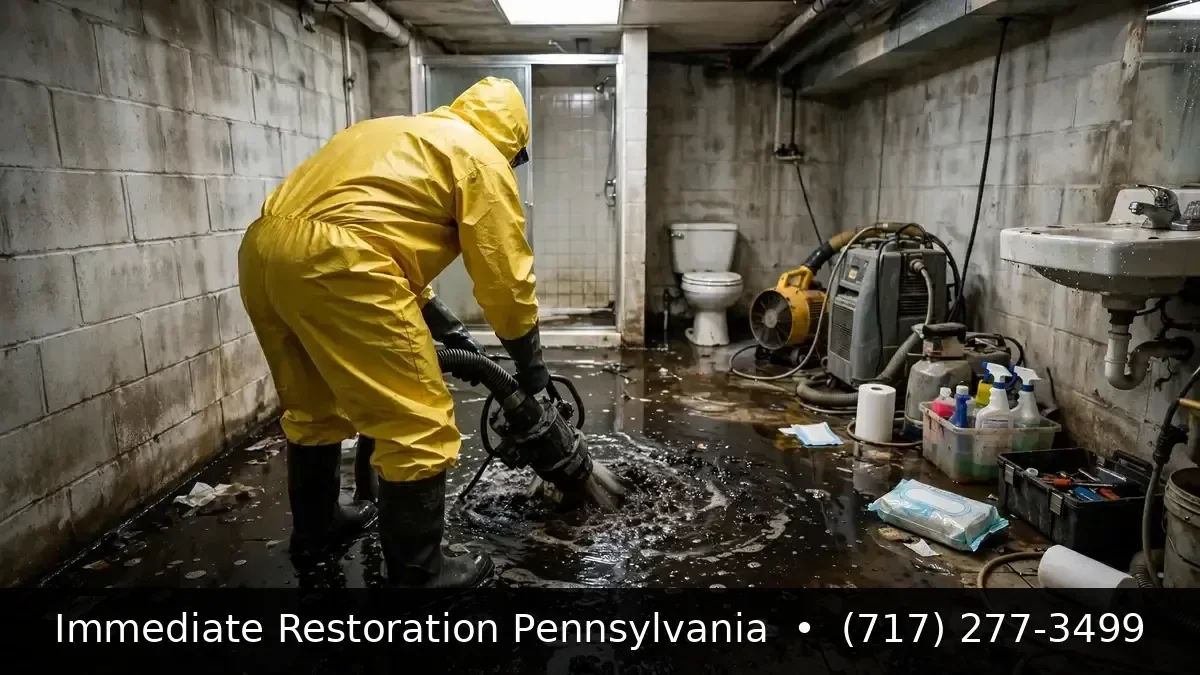
- Valley-flood extraction — In-the-Run flooding is contaminated runoff. We pump, remove silt and debris, and disinfect — not just pump.
- Main-break response — Two feet of water in January, a flooded intersection in December: we handle clean-water pipe floods fast, and we document for the insurer from the first minute.
- Denied-claim documentation — When insurers say the water "came from outside," paperwork is the appeal. We photograph, meter, and record everything.
- Drying for brick rowhouses and twins — Controlled dehumidification for masonry that holds moisture, verified by daily readings.
- Practical defenses — Sump pumps with battery backup, sealed low entries, backwater valves — the proven kit for a valley that keeps filling.
Areas We Cover Around Greenfield
In the Run · Saline Street · Boundary Street · Hazelwood Avenue · Beechwood Boulevard · Murray Avenue · Four Mile Run Road · Squirrel Hill border
Nearby areas we serve: Pittsburgh, PA · Allentown, Pittsburgh · Beechview, Pittsburgh · Bloomfield, Pittsburgh · Brookline, Pittsburgh · Carrick, Pittsburgh
Related guides: Pittsburgh Floods: The 1936 46-Foot St. Patrick’s Flood · Water Damage Insurance Claims in Pennsylvania
Cost of Water Damage Restoration in Greenfield
- Basement extraction and drying: roughly $2,000–$6,500
- Water line break cleanup: roughly $1,500–$5,500
- Sewage-contaminated flood cleanup: roughly $2,500–$8,000
Free estimates, confirmed by inspection. If your insurer has denied a claim, bring the letter — our documentation is built for appeals.
Call Immediate Restoration Pennsylvania for 24/7 Emergency Service in Greenfield
Four Mile Run is underground, but its floods are not. Whether the water comes from the sky, the buried valley, or a broken main, Immediate Restoration Pennsylvania at (717) 277-3499 — 24/7 dispatch in Greenfield, free estimates, claim-ready documentation.
Call (717) 277-3499 NowFrequently Asked Questions
Why does "In the Run" flood if the stream was buried
Because burying a stream doesn't remove the valley. Four Mile Run still drains the same low ground through the M-29 outfall — the third-largest combined sewer overflow in the system — and when 1.6 inches falls in 30 minutes, the 1800s brick culvert can't carry it. The water goes where the valley always sent it: into The Run.
What do I do if my insurer denies a water-line flood claim
Photograph water lines on walls, save the utility's incident record, and call us immediately: our moisture mapping, timestamps, and cause-of-loss notes are built to support disputed claims like the January 2026 Greenfield denial.
What's the M-29 outfall, and does it affect my basement
It's the 450-foot brick culvert (1892 keystone) where Four Mile Run's buried flow reaches the Monongahela at Second Avenue — the system's third-largest combined sewer overflow. When it surcharges in a big storm, pressure backs up through the whole valley's drains. If your basement floods during cloudbursts, M-29 is part of why.
Can a buried stream really push water into my home
Yes — through the drains, not the walls. The buried stream's watershed feeds the combined sewers; when the system overwhelms, water reverses through floor drains and low fixtures. A backwater valve plus a battery-backed sump pump is the standard defense for valley-floor homes.