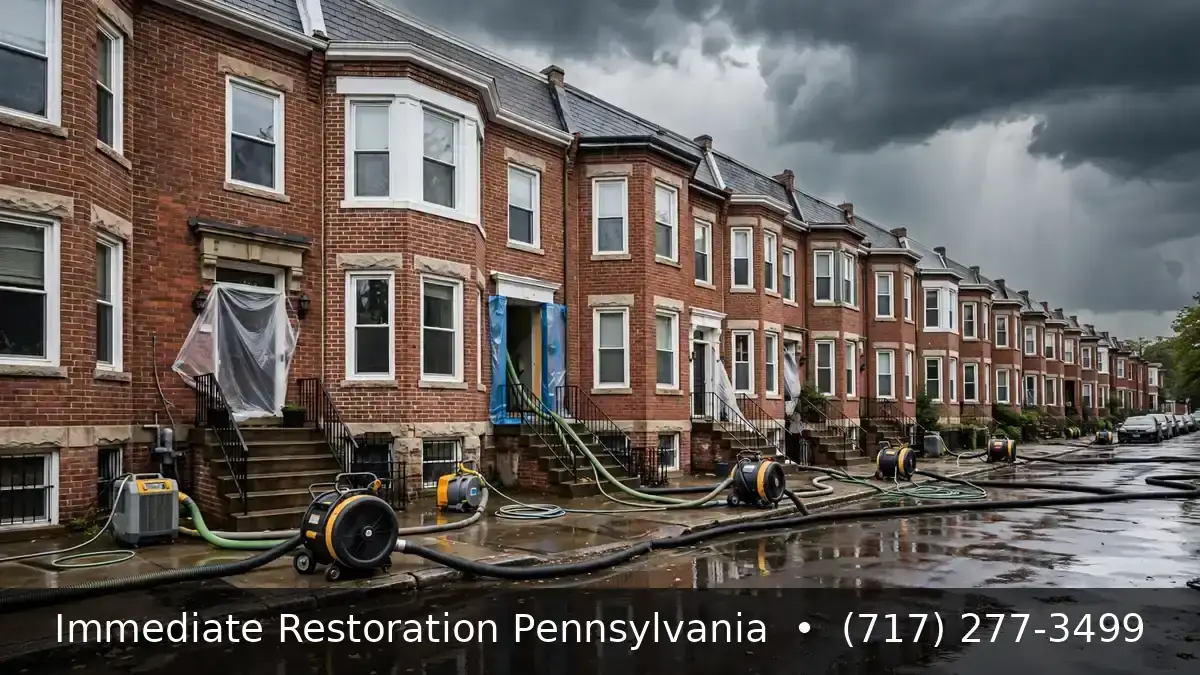
# Water Damage Restoration in Philadelphia, PA
When the Schuylkill River climbed to 16.35 feet in September 2021 — the second-highest level ever recorded at the 30th Street Station gauge, just inches below the 1869 record — Philadelphia got a crash course in what water can do. The Vine Street Expressway turned into a canal. Main Street in Manayunk was under river water. More than 100 water rescues were reported across the city. Immediate Restoration Pennsylvania provides 24/7 water damage restoration across Philadelphia: emergency water extraction, structural drying, dehumidification, sewage cleanup, and mold remediation, dispatched from teams positioned throughout the city. Whether your South Philadelphia rowhouse basement backs up during a cloudburst, or your Center City brownstone's century-old lateral fails, one call gets a certified crew rolling to your door — day or night.
Our Water Damage Services in Philadelphia
Philadelphia's Triple Water Threat: Sewers, Rivers, and Old Rowhouses
Philadelphia's water-damage story comes from three directions at once. First, the combined sewer system: roughly 60% of the city carries stormwater and sewage in the same pipes, and when rain falls at 1–2 inches per hour, the system surcharges — pushing sewage-laden water back through floor drains and basement fixtures. The Philadelphia Water Department (PWD) records an average of 12.7 billion gallons a year of combined sewer overflow discharging into the Delaware, Schuylkill, and tributaries. Second, the rivers and creeks: the Schuylkill and Delaware, plus flash-prone tributaries like Cobbs Creek, Frankford Creek, Pennypack Creek, and the Wissahickon, all pushed past major flood stage during Ida. Third, the housing stock: vast stretches of pre-1940 brick rowhouses with aging foundations, century-old clay sewer laterals, and — crucially — finished basements full of drywall, carpeting, and electrical systems that floodwaters ruin.
This isn't just a flood-zone problem. PWD names Germantown, Kensington, Northern Liberties, Center City, South Philadelphia, and Port Richmond among the neighborhoods most impacted by basement sewer backups — areas far from any river. And the rainfall trend is grim: the National Weather Service issued nearly triple its average number of flood warnings for the Philadelphia region by early September 2026, much of it from isolated thunderstorms rather than tropical systems. Even the city's average water main is 76 years old, and main breaks routinely flood streets and basements without warning.
Why Philadelphia Homeowners Choose Immediate Restoration Pennsylvania
- Truly 24/7 emergency dispatch — Philadelphia flooding doesn't wait for business hours, and neither do we. Our emergency crews respond to burst pipes, sewage backups, and storm flooding around the clock, including holidays.
- Registered in Pennsylvania — We are registered under Pennsylvania's Home Improvement Consumer Protection Act, so your project is backed by a documented, state-recognized contractor.
- Rowhouse expertise — Philadelphia rowhouses have shared party walls, narrow stairwells, and basements below street level. We size drying equipment for tight rowhouse footprints, protect shared walls, and coordinate with neighbors when a common sewer line is the culprit.
- Insurance documentation — From the storm-damage photos to the moisture-mapping reports and drying logs, we build the paper trail your homeowner's insurance claim needs.
Our Water Damage Restoration Process
- Inspection and moisture mapping — We find every pocket of trapped water with infrared cameras and moisture meters, including water wicking up party walls and under finished floors.
- Water extraction — Truck-mounted and portable extractors pull standing water fast — the faster the extraction, the less secondary damage.
- Structural drying and dehumidification — Air movers and commercial dehumidifiers dry framing, masonry, and subfloors to target moisture levels, verified with daily readings.
- mold prevention — Antimicrobial treatment on affected surfaces stops mold before it starts in Philadelphia's humid summers.
- Rebuild and restoration — Drywall, flooring, and finishes restored so the space looks like the water was never there.
Neighborhoods and Nearby Areas We Serve
South Philadelphia · Center City · Fishtown · University City · Manayunk · Chestnut Hill · Germantown · Mount Airy · Roxborough · Passyunk Square · Old City · Society Hill · Kensington · Brewerytown · Fairmount · East Falls · Port Richmond · Mayfair · Eastwick · Nearby: Upper Darby, Bensalem, Norristown, King of Prussia, Cheltenham, Abington
Nearby areas we serve: Brewerytown, Philadelphia · Bridesburg, Philadelphia · Bustleton, Philadelphia · Callowhill, Philadelphia · Center City, Philadelphia · Chestnut Hill, Philadelphia
Related guides: Hurricane Ida’s Philly Flooding: Lessons for Homeowners · Sump Pump Failure and Basement Flooding in PA
Official flood resources: Ready.gov — Floods · FEMA — Flood Insurance · FEMA Flood Maps · PA Emergency Management (PEMA)
Water Damage Restoration Cost in Philadelphia
Costs vary with the scope, but Philadelphia homeowners typically see the following ranges (estimates — your free inspection confirms the exact figure):
- Small, contained cleanup (single room, clean water): roughly $1,200–$2,500
- Whole-basement water extraction and drying: roughly $3,000–$7,000
- Sewage backup cleanup with sanitizing: roughly $2,500–$8,000
- mold remediation after prolonged moisture: roughly $2,000–$6,000+
Cost drivers: water category (clean vs. sewage), how long the water sat, square footage, whether finished materials need tear-out, and Philadelphia's high labor costs. Insurance often covers sudden, accidental events — document everything and call us before cleanup begins.
Commercial Water Damage in Philadelphia
From Center City office towers with flooded parking garages to South Philly restaurants on the East Passyunk corridor, commercial losses carry revenue risk on top of repair costs. We offer priority commercial response, after-hours work to avoid disrupting business, large-scale desiccant drying for big footprints, and detailed documentation for business-interruption claims.
Call Now for 24/7 Emergency Water Damage Service in Philadelphia
Water damage gets worse by the hour — mold starts within 24–48 hours, and Philadelphia's combined sewers mean every hour of standing water is an hour of contamination risk. Call Immediate Restoration Pennsylvania now at (717) 277-3499 for immediate dispatch anywhere in Philadelphia. Free estimates. Insurance documentation included.
Call (717) 277-3499 NowFrequently Asked Questions
How fast can you reach my home in Philadelphia during a storm
Our crews are positioned across the city and typically arrive within 60–90 minutes for emergencies. During major events like an Ida-scale storm, call immediately — we triage by severity and keep a live queue.
My basement flooded but there's no river nearby. Is this a sewer backup
In Philadelphia, very likely. About 60% of the city uses a combined sewer system, and heavy rain can push stormwater-sewage mix back through basement floor drains in neighborhoods like South Philly, Kensington, and Germantown. Don't walk through it unprotected — sewage-contaminated water carries bacteria and pathogens.
Does homeowners insurance cover water damage in Philadelphia
Sudden, accidental events (burst pipes, appliance failures, storm-driven rain through a damaged roof) are usually covered; gradual leaks and rising floodwater typically require separate flood insurance. We document the cause and the damage to support your claim.
How long does drying take in a Philadelphia rowhouse basement
Typically 3–5 days for a standard basement with professional equipment, verified by moisture readings. Finished basements with drywall and carpet can take longer if materials must be removed.
Can you help with mold after my basement flooded
Yes. Philadelphia's humidity makes post-flood mold growth a serious risk — mold can start within 24–48 hours. We provide antimicrobial treatment, containment, and full mold remediation if growth has already started.
Should I pump out my own basement after a flood
Not if the water may be sewage-contaminated, and never around energized electrical panels. We pump and extract safely, then dry, sanitize, and restore — which also protects your insurance position.