· Last updated · 8 min read
By Immediate Restoration Pennsylvania
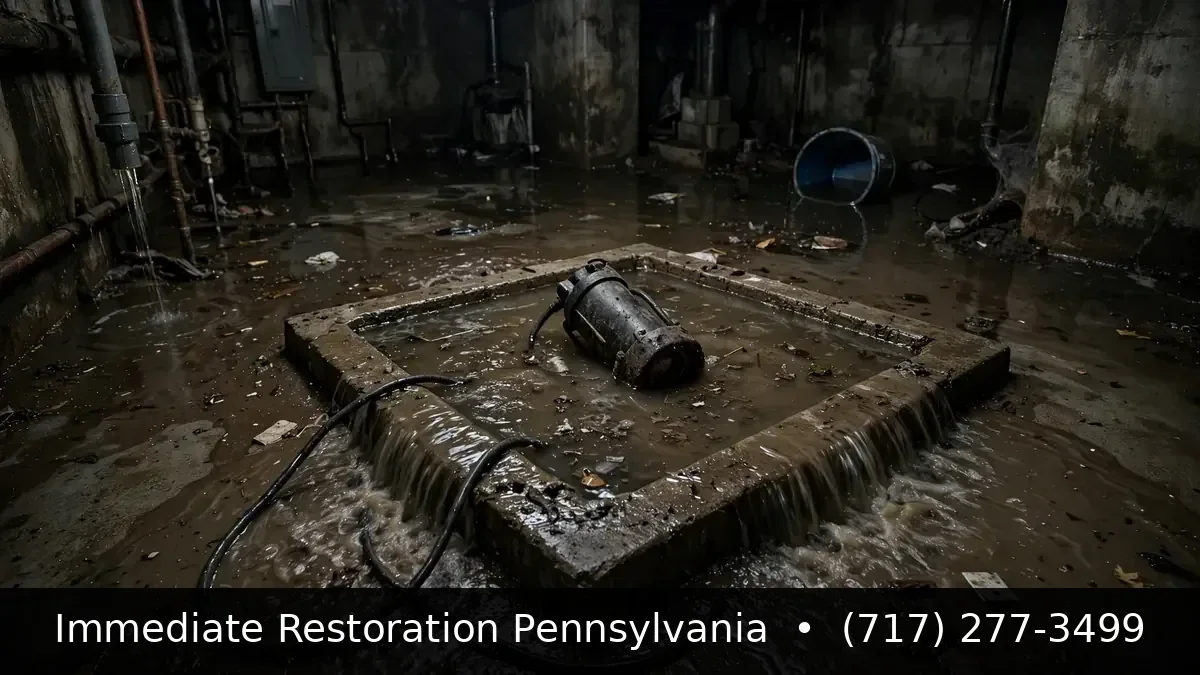
In much of Pennsylvania — from the rowhouse basements of Philadelphia to the ranch homes of the Lehigh Valley — the sump pump is the single most important piece of flood-protection equipment a homeowner owns. It sits quietly in its pit for months, then during a spring downpour or a tropical-remnant deluge it must run hundreds of cycles without a hiccup. When it doesn't, basements fill fast: a failed pump during a heavy storm can let inches of water accumulate in hours.
Key Takeaways
- The same handful of causes shows up in nearly every flooded-basement call we run:
- A battery-backup sump pump is a second, DC-powered pump mounted beside your primary unit, running off a deep-cycle marine battery that trickle-charges from household power.
- Test your pump every spring and fall, and after any major storm:
- Replace the pump — don't wait for a storm to test it — if you notice loud grinding or rattling (worn bearings), frequent on-off cycling (bad float switch), visible rust or corrosion, continuous runnin
Insurance data consistently ranks sump pump failure among the top causes of basement water claims in the Northeast. Yet most failures are preventable — they come down to power loss, neglected maintenance, or undersized equipment. This guide covers why sump pumps fail, how backup systems work, and the simple routine that keeps yours ready when the water rises.
Why sump pumps fail in Pennsylvania homes
The same handful of causes shows up in nearly every flooded-basement call we run:
- Power outage. The number-one cause. Heavy storms knock out power exactly when the pump is needed most. No electricity, no pumping — and the pit fills within minutes.
- Stuck or failed float switch. The float that triggers the pump can jam against the pit wall, tangle in its own cord, or simply wear out. A pump that never turns on is the same as no pump at all.
- Clogged or frozen discharge line. Debris, ice, or a crushed pipe blocks the discharge, so the pump runs but the water goes nowhere — or backs up into the basement.
- Burned-out motor. Pumps have finite lifespans, typically 7–10 years. An aging motor working against a heavy inflow can overheat and die mid-storm.
- Undersized or mis-installed pump. Too small a pump for the inflow, a pit that's too narrow, or a missing check valve (which lets discharged water flow back into the pit) all set up failure.
- Tripped breaker or unplugged unit. It sounds absurd, but we've seen pumps unplugged for a garage project and never plugged back in, and dedicated circuits tripped by the pump's own startup surge.
Battery backup systems: your second line of defense
A battery-backup sump pump is a second, DC-powered pump mounted beside your primary unit, running off a deep-cycle marine battery that trickle-charges from household power. When the power fails — or when the primary pump is overwhelmed — the backup takes over automatically, pumping thousands of gallons on a single charge. Most systems run 6–12 hours of intermittent pumping, and some can be extended with a second battery.
There are two main types:
- Battery backup (DC): Independent second pump with its own float. Best for homes that lose power often or have finished basements. Self-tests and alarms warn you when the battery needs replacement (typically every 3–5 years).
- Water-powered backup: Uses municipal water pressure to siphon pit water out — no battery, no electricity at all. Excellent reliability, but it consumes tap water and isn't allowed in every municipality, so check local code.
For Pennsylvania homes with finished basements, we recommend both a quality primary pump and a battery backup with a high-water alarm. The alarm alone — a $30 device that screams when the pit overfills — has saved countless basements.
The 20-minute maintenance routine (do it twice a year)
Test your pump every spring and fall, and after any major storm:
- Pour water in the pit. Fill a 5-gallon bucket and pour it in slowly. The pump should kick on quickly, lower the water, and shut off. If it hesitates or runs continuously, investigate.
- Check the float. Make sure it moves freely and isn't tangled or wedged against the pit wall.
- Inspect the discharge line. Confirm the outlet outside is clear of mulch, ice, and debris, and that water discharges at least 10–20 feet from the foundation.
- Clean the pit. Remove silt, gravel, and debris that can jam the float or clog the intake screen.
- Test the check valve. After the pump stops, listen — if water audibly rushes back into the pit, the check valve has failed.
- Check the backup battery. Verify the charger is powered, terminals are clean, and the battery holds a charge. Replace batteries every 3–5 years.
- Confirm the alarm works. Lift the float or test button and make sure the high-water alarm sounds.
Signs your sump pump needs replacement
Replace the pump — don't wait for a storm to test it — if you notice loud grinding or rattling (worn bearings), frequent on-off cycling (bad float switch), visible rust or corrosion, continuous running without lowering water, or simply age: at 7+ years old, a pump is living on borrowed time. A quality cast-iron submersible 1/3- or 1/2-HP pump from a reputable brand, professionally installed, is a modest investment compared to a single basement flood.
When the pump fails and the basement floods
If you come home to standing water, don't wade in until you've cut power to the basement at the breaker — submerged outlets and appliances are an electrocution risk. Then call for help fast. Every hour of standing water means deeper wicking into drywall, insulation, and framing, and Pennsylvania's humid summers can start mold growth on damp basement materials within 24–48 hours.
Our emergency flood cleanup teams pump out flooded basements around the clock, then run the full drying and dehumidification process — industrial dehumidifiers, air movers, and moisture-meter verification — so the basement is genuinely dry, not just surface-dry. And if the flood was your wake-up call, ask us about backup pump options while we're there: the best time to fix the weak link is before the next storm finds it.
Frequently Asked Questions
How long do sump pumps last? Most residential sump pumps last 7–10 years. Cast-iron submersible models from quality brands tend to outlast cheap thermoplastic pedestal pumps. Replace proactively at 7+ years, especially if your basement is finished.
How long will a battery backup sump pump run? A typical deep-cycle battery backup runs 6–12 hours of intermittent pumping — enough to bridge most storm-related outages. Adding a second battery or a generator extends coverage through longer blackouts.
Why does my sump pump run constantly? Constant running usually means a stuck float switch, a failed check valve letting water flow back into the pit, an undersized pump, or a high water table overwhelming the system. Have it inspected before it burns out.
Do I need a permit to install a backup sump pump in PA? Rules vary by municipality. Most PA towns don't require a permit for a battery-backup pump, but water-powered backups that connect to municipal water may need approval. Check with your local code office.
For official guidance on preparedness and recovery, see Ready.gov’s flood preparedness guidance.
Sources
- https://www.ready.gov/floods — Ready.gov’s flood preparedness guidance
Related Reading
If this guide helped, these next reads go deeper:
- Frozen Pipes in Pennsylvania: Winter Prevention Tips
- Sewer Backups in Philly Basements: What to Know
- Drying & Dehumidification Process Explained
- Emergency Flood Cleanup Services
- Water Damage Restoration
Where we help: Philadelphia, PA · Pittsburgh, PA · Lancaster, PA · Erie, PA