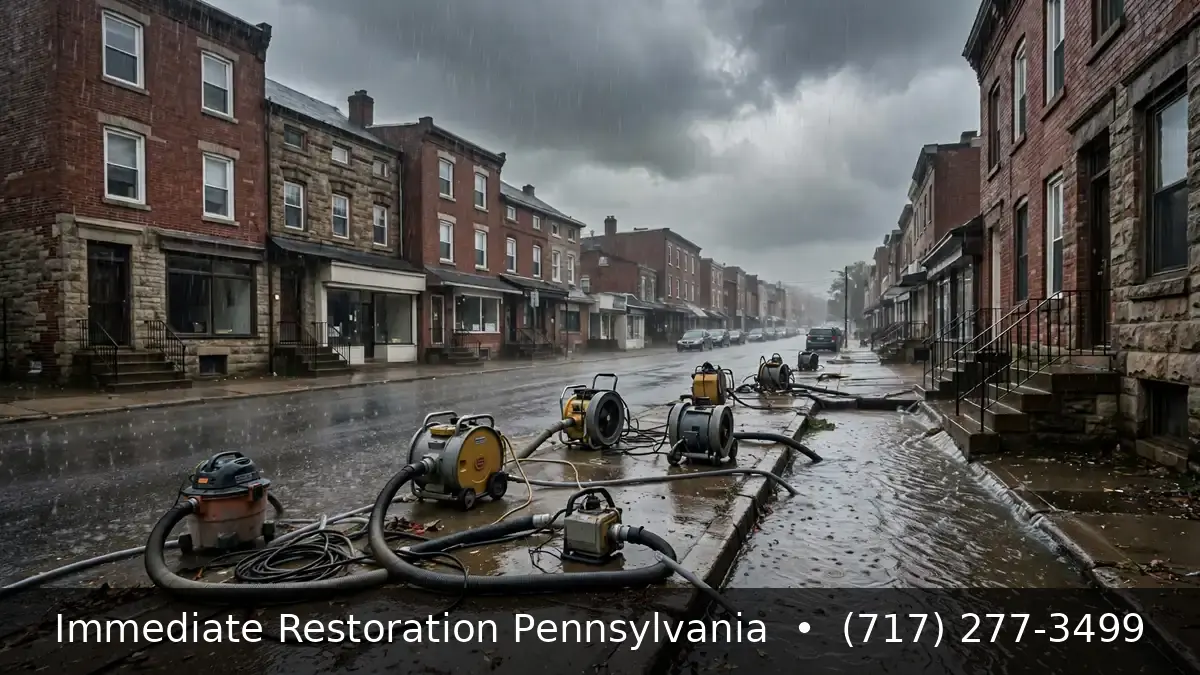
# Water Damage Restoration in Reading, PA
In June 1972, Hurricane Agnes dropped 12 to 18 inches of rain on Berks County, and the Schuylkill River rose 20 feet over its banks at Douglassville — carrying away an estimated 140,000 to 190,000 barrels of waste oil and sludge from a reclamation plant's lagoons, plus drums of hazardous chemicals scattered across the countryside. It remains the benchmark disaster for the Schuylkill corridor. Reading has been living with the river ever since: the National Weather Service gauge at Reading defines flooding in street names — 15.5 feet puts water on Water and Canal Streets, 16 feet reaches Franklin, Grape, and Chestnut, 18 feet floods West Reading streets and the US 222/422 bypass. In July 2025, the Spring Street Subway submerged again, with water rescues near Berkshire Mall and residents saying the spot has flooded "for years and years." Immediate Restoration Pennsylvania provides 24/7 water damage restoration across Reading: emergency extraction, structural drying, sewage cleanup, and mold remediation.
Our Water Damage Services in Reading
A River City Ringed by Hills
Reading's geography concentrates water. The Schuylkill runs through the city in a valley ringed by hills — Mount Penn on one side, Neversink on the other — so the river corridor and the hillside runoff zones below it carry the risk. The gauge thresholds tell the story in concrete terms: at 15.5 feet the river takes Water and Canal Streets; at 16 it spreads to Franklin, Grape, and Chestnut; at 18 it reaches into West Reading and closes highway lanes. Ida in 2021 brought only minor flooding at Reading itself — but "minor" on this gauge still means water where people live and work, and the river's bigger moods are a matter of record, not speculation.
The hills add a second axis. College Heights, tucked against Mount Penn below the Pagoda — the 1907 Japanese-style landmark at 98 Duryea Drive — takes hillside runoff in heavy rain, and the older housing stock throughout the city's Victorian-era districts, like Centre Park's 19th-century rowhouses and twins, carries the classic aging-basement profile: old foundations, old laterals, and finished lower levels. A 2012 FEMA remap put more than 3,000 Berks County parcels into or near flood zones, and affected homeowners faced premiums over $2,000 a year with mortgage lenders forcing coverage — a financial shock that made the flood risk impossible to ignore. Then there are the chronic spots: the Spring Street Subway's repeated submersions, the July 2025 rescues in Muhlenberg, Cumru, and South Heidelberg — proof that Reading's water problem is as much about cloudbursts and overwhelmed drains as about the river's big crests.
Why Reading Homeowners Choose Immediate Restoration Pennsylvania
- 24/7 emergency dispatch — River rises and cloudbursts don't keep office hours.
- Registered in Pennsylvania — Registered under the Home Improvement Consumer Protection Act.
- Hillside and riverfront experience — We handle both the Schuylkill corridor and the runoff zones below Mount Penn.
- Insurance documentation — Moisture maps, drying logs, and photos for every claim.
Our Water Damage Restoration Process
- Inspection and moisture mapping — Find every wet pocket with infrared and meters.
- Water extraction — Fast removal with truck-mounted and portable equipment.
- Structural drying — Air movers and dehumidifiers, verified daily.
- mold prevention — Antimicrobial treatment; full remediation where needed.
- Rebuild — Drywall, flooring, and finishes restored.
Neighborhoods and Nearby Areas We Serve
Centre Park Historic District · College Heights · Hampden Heights · Glenside · Oakbrook · Downtown Reading · Mount Penn edge · West Reading · Nearby: Wyomissing, Shillington, Muhlenberg, Exeter, Birdsboro, Pottstown
Nearby areas we serve: College Heights, Reading · Glenside, Reading · Hampden Heights, Reading · Oakbrook, Reading · Centre Park, Reading · Columbia, PA
Related guides: Tropical Storm Agnes: The 1972 Susquehanna Flood · Water Damage Insurance Claims in Pennsylvania
Official flood resources: Ready.gov — Floods · FEMA — Flood Insurance · FEMA Flood Maps · PA Emergency Management (PEMA)
Water Damage Restoration Cost in Reading
- Single-room clean-water cleanup: roughly $1,200–$2,500
- Basement extraction and drying: roughly $2,500–$7,000
- Sewage backup with sanitizing: roughly $2,500–$8,000
Estimates — free inspection confirms pricing.
Commercial Water Damage in Reading
Downtown storefronts, the hospitality corridor, and industrial buildings along the river can't afford extended downtime. Priority commercial response, after-hours mitigation, and business-interruption documentation available.
Call Now for 24/7 Emergency Water Damage Service in Reading
The Schuylkill made this city — don't let it unmake your home. Immediate Restoration Pennsylvania at (717) 277-3499 — 24/7 dispatch, free estimates, insurance-ready documentation.
Call (717) 277-3499 NowFrequently Asked Questions
At what river level should I worry about my Reading property
The NWS gauge at Reading: flooding begins at 15.5 feet (Water and Canal Streets), reaches Franklin, Grape, and Chestnut at 16 feet, and hits West Reading and the 222/422 bypass at 18 feet. If you're near the corridor, watch the gauge during major storms.
My street isn't near the river but floods anyway. Why
Hillside runoff and overwhelmed storm drains. Reading's hills shed water fast, and cloudbursts can flood low spots — like the Spring Street Subway — far from the Schuylkill. Sump pumps with battery backup and proper grading are the standard defenses.
Do I need flood insurance in Reading
The 2012 FEMA remap put 3,000+ Berks parcels in or near flood zones. If your lender requires it, you need it; even if not required, it's worth pricing near the river corridor and known flood streets.
How do you handle the chemical contamination risk from river floods
Agnes showed what the Schuylkill can carry. We treat all river floodwater as contaminated — full protective protocols, extraction, and sanitization of everything the water touched.
Can you dry an older Victorian home without damaging it
Yes, with measured drying: daily moisture readings and protocols suited to old masonry, plaster, and wood. We verify dryness rather than guessing.
How quickly should I call after a flood
Immediately. Mold starts in 24–48 hours, and every hour of standing water increases the damage. We triage emergencies around the clock.