Moisture Mapping
Thermal imaging and penetrating meters map every wet material before equipment is placed — drying plans target reality, not guesses.
Quick answer: Most Pennsylvania homes dry in 3–5 days with commercial dehumidifiers and air movers — verified dry with moisture meters, not guesswork.
| Timeline | 3–5 days typical |
|---|---|
| Equipment | Commercial dehumidifiers + air movers |
| Verification | Moisture-meter readings |
Scientific drying: the right equipment, the right placement, and proof it's dry.
Thermal imaging and penetrating meters map every wet material before equipment is placed — drying plans target reality, not guesses.
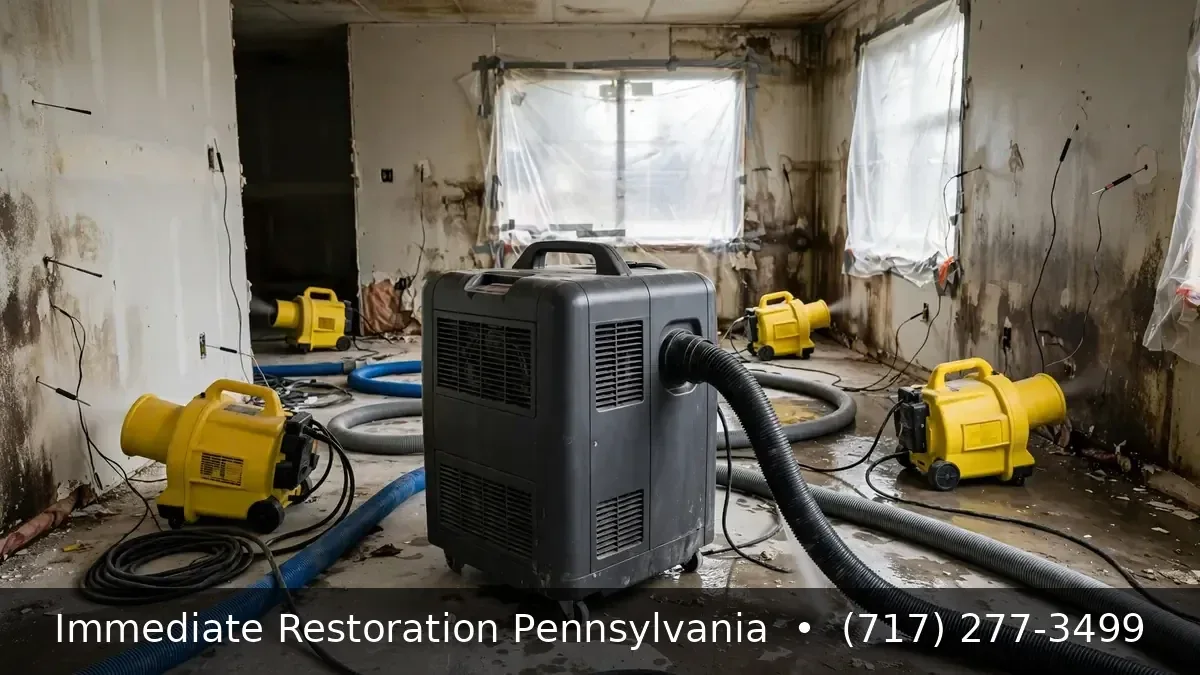
High-velocity air movers create airflow across wet surfaces, accelerating evaporation from framing, subfloors, and drywall.
Commercial LGR dehumidifiers pull massive moisture loads from the air, keeping humidity low enough for materials to release water.
Technicians check and log moisture readings daily, repositioning equipment until every material hits verified dry goals.
Here's what most people get wrong about water damage: the visible water is the easy part. The real damage hides in framing that reads 30% moisture, subflooring wicking water sideways, and insulation holding gallons behind intact-looking drywall. Fans from the hardware store move air; they don't dehumidify it — in Pennsylvania's humid summers, they can actually slow drying by recirculating saturated air. Our drying and dehumidification is engineered: psychrometrics, not hope.
Every drying job starts with moisture mapping — we establish what's wet, how wet, and what “dry” means for each material (dry standard). Then we place equipment to create the pressure and airflow each space needs: directed air across wet walls, dehumidifiers sized to the cubic footage and moisture load, sometimes specialty floor-mat systems for hardwood or injectidry panels for wall cavities. Daily readings track progress, and equipment stays until materials verify dry — not until a calendar says so.
This rigor is what prevents the callbacks: the mold that blooms behind a “dried” wall, the hardwood that cups months later, the musty smell that never leaves. Whether we're drying after water damage restoration, a storm flood, or chronic basement dampness in Philadelphia, Pittsburgh, or Harrisburg — you get documentation proving your property is dry.
Pennsylvania is hard to dry. Summer humidity regularly sits above 70%, which means the air itself fights evaporation — without powerful dehumidification, wet materials simply stop releasing moisture. Our dense housing stock compounds it: stone foundations, plaster walls, and hardwood floors all hold water far longer than modern drywall-and-vinyl construction.
Winter brings the opposite problem: cold materials dry slowly, and heating a wet space without dehumidification just moves moisture into wall cavities. We adjust every drying plan for season, material, and structure — the psychrometric math doesn't care what month it is, but the equipment setup absolutely does.
Measure, dry, verify — the science of getting truly dry.
Map Moisture
Thermal imaging and meters establish exactly what's wet and set dry goals for each material.
Place Equipment
Air movers and LGR dehumidifiers are sized and positioned for your space's volume and moisture load.
Monitor Daily
Technicians log readings every day, adjusting equipment placement as materials release moisture.
Verify Dry
Equipment is removed only when all materials hit documented dry standards — with logs for your records.
Licensed, insured, and on call 24/7 — the crew Pennsylvania trusts when water won't wait.
24/7 Live Answer
A real person picks up day or night — nights, weekends, and holidays included.
Licensed & Insured
Fully licensed and insured for residential and commercial work statewide.
Workmanship Warranty
Every job backed by a written workmanship warranty and photo documentation.
Straight answers to the questions Pennsylvania homeowners and property managers ask us most.
Cities we serve: Philadelphia, PA · Pittsburgh, PA · Allentown, PA · Erie, PA · Reading, PA · Scranton, PA · Lancaster, PA · Harrisburg, PA · Altoona, PA · York, PA — 24/7 Emergency Crew · State College, PA · Wilkes-Barre, PA — plus all 251 Pennsylvania service areas.
Related guides: Drying & Dehumidification Process Explained · Sump Pump Failure and Basement Flooding in PA
Official resources: EPA — Mold Guidance · Ready.gov — Floods · PA Emergency Management Agency (PEMA)
Water problems rarely travel alone — these services often go hand in hand.
Complete restoration including professional drying — extraction through rebuild.
View Water Damage RestorationImproper drying causes mold. If it's already growing, certified remediation handles it.
View Mold RemediationStanding water removed fast, then professional drying finishes the job right.
View Emergency Flood CleanupNeed drying & dehumidification anywhere in Pennsylvania? Our team is available 24/7 for prompt, professional service.
Phone
(717) 277-3499Address
555 Walnut St, Harrisburg, PA 17101
Hours
24/7 Emergency Available
Mon–Sun: 24 hours