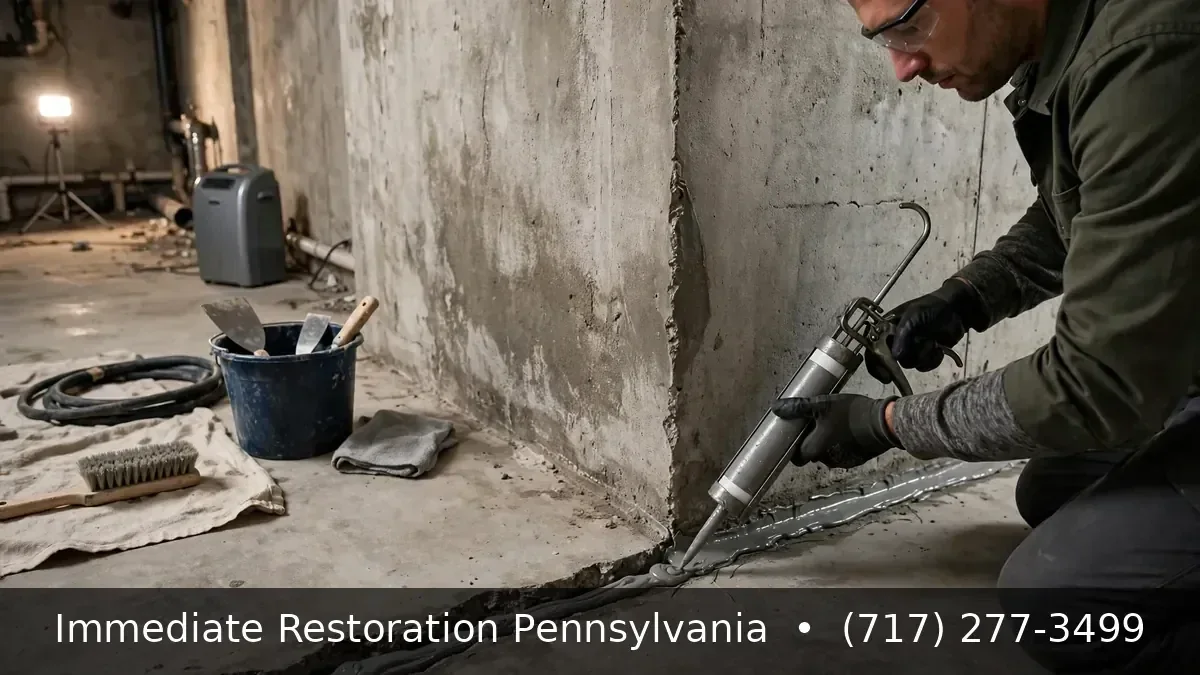
# Water Damage Restoration in Homewood, Pittsburgh
Scientists are studying Homewood's basements. Not the foundations — the mold in them. A RAND Corporation and University of Pittsburgh "Health and High Water" study — funded by a roughly $1.35 million U.S. EPA grant — surveyed basement wetness, radon, and indoor air quality in Homewood and the Hill District, neighborhoods prone to flooding from the buried Negley Run watershed. The finding: roughly three-quarters of homes surveyed had experienced basement wetness — usually not a dramatic flood, but constant dampness — and the mold that grows in it triggers asthma, allergies, and skin rashes. Findings were presented to residents at a March 26, 2026 community forum at 622 N Homewood Avenue. Immediate Restoration Pennsylvania provides 24/7 water damage restoration in Homewood: emergency extraction, structural drying, sewage cleanup, and — critically here — mold remediation for the early-1900s brick rowhouses of the Negley Run watershed.
Water Damage Services in Homewood
The Basements Scientists Are Studying
Homewood's flooding doesn't announce itself with a crest or a news crew. The Negley Run watershed — the same buried stream behind Shadyside's floods — runs beneath the neighborhood, and the water comes up through floors, weeps through walls, and lingers. PWSA's stormwater planning calls Negley Run a priority watershed, citing historic flooding and Homewood's vulnerability to recurring floods. In 2022, Grounded Strategies hired Homewood resident Khadijah Bey as a door-to-door stormwater ambassador; her summary: "A lot of residents are having flooding in their basements. A lot of residents." The Army Corps of Engineers held a flooding workshop at the Carnegie Library of Homewood that May. Pittsburgh's average annual rainfall has climbed from about 30 inches in 1840 to about 40 today, and the wettest storms are 13% wetter than 60 years ago.
This is the watershed's chronic-dampness page: abandoned homes with missing gutters shed water onto neighbors' foundations, combined sewers surcharge, and basements stay wet enough for mold but never wet enough for the cameras.
Our Homewood Approach
- Dampness mapping, not just pumping — We meter walls, floors, and behind finished surfaces to find where the moisture lives — including the "never visibly floods" kind the RAND study flagged.
- Source identification — Negley Run seepage, combined-sewer backup, or plumbing failure each gets a different fix and a different claim path.
- Deep drying for brick rowhouses — Early-1900s masonry holds moisture for weeks. We dry to verified targets with daily readings.
- Health-grade mold work — In this neighborhood, mold isn't cosmetic. Antimicrobial treatment as standard; full remediation when the study's findings show up in your basement.
- Long-term defenses — Interior drainage, sump pumps with battery backup, backwater valves — and honest guidance on what the city and FEMA buyout process can and can't do for chronically wet blocks.
Areas We Cover Around Homewood
Homewood Avenue corridor · North Homewood · South Homewood · Larimer border · East Liberty edge · Point Breeze North · Wilkinsburg line · Lincoln-Lemington side
Nearby areas we serve: Pittsburgh, PA · Allentown, Pittsburgh · Beechview, Pittsburgh · Bloomfield, Pittsburgh · Brookline, Pittsburgh · Carrick, Pittsburgh
Related guides: Pittsburgh Floods: The 1936 46-Foot St. Patrick’s Flood · Drying & Dehumidification Process Explained
Cost of Water Damage Restoration in Homewood
- Basement extraction and drying: roughly $2,000–$6,500
- Chronic-dampness mold remediation: roughly $2,000–$6,000+
- Sewage backup with sanitizing: roughly $2,500–$8,000
Free inspections, always. If your basement is damp more often than dry, the inspection is the most valuable thing we do — it finds the moisture before the mold does.
Call Immediate Restoration Pennsylvania for 24/7 Emergency Service in Homewood
Homewood's basements made it into a national study. Yours doesn't have to stay part of the statistic. Immediate Restoration Pennsylvania at (717) 277-3499 — 24/7 dispatch, free moisture inspections.
Call (717) 277-3499 NowFrequently Asked Questions
Why are scientists studying Homewood's basements
Because the dampness is a public-health problem, not just a nuisance. The RAND/Pitt "Health and High Water" study, backed by about $1.35 million from the EPA, documented basement wetness in three-quarters of surveyed homes and linked the resulting mold to asthma and allergies. Homewood is Pittsburgh's nationally documented case of chronic wet-basement flooding.
What did the RAND study find about mold in Homewood homes
That it's everywhere dampness is — and dampness is in roughly three-quarters of homes. Researchers found the constant-dampness pattern (not just storm floods) grows the mold that triggers respiratory problems. The March 2026 community forum at 622 N Homewood Ave presented the findings with a resource fair for home repair and flood mitigation.
How is chronic dampness different from flooding for my home
Flooding is an event; dampness is a condition. A flood gets pumped and dried. Chronic dampness keeps feeding mold between storms, rots sill plates slowly, and never triggers an insurance claim. It needs moisture mapping and long-term defenses, not just a pump.
What can I do about seepage if I can't afford a full drainage system
Start with the free inspection and the cheap wins: extend downspouts away from the foundation, regrade soil against the house, and seal obvious entry points. A sump pump with battery backup is the single best mid-range investment. We prioritize fixes by impact so limited budgets still move the needle.