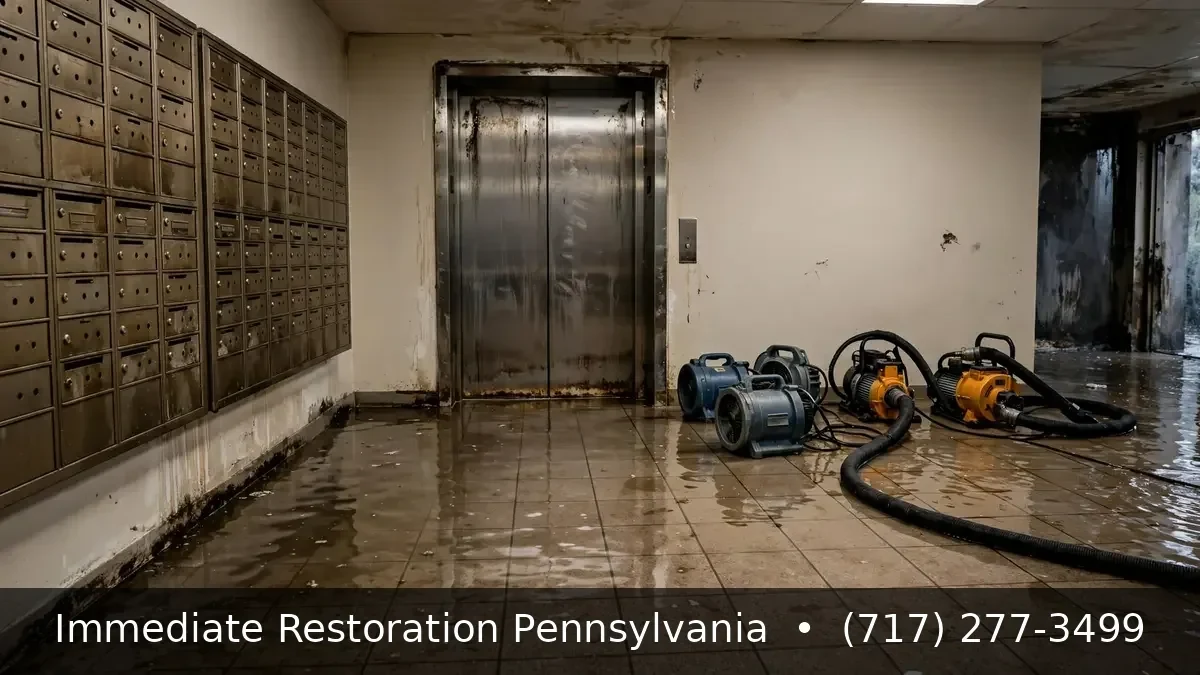
# Water Damage Restoration in Lawrenceville, Pittsburgh
On July 30, 2024, a driver had to be rescued from a flooded roadway at Sassafras Street and Liberty Avenue in Lawrenceville — two feet of water on the road at 9:44 in the morning. Sassafras Street is a repeat problem: the same intersection floods in heavy rain events again and again, the Allegheny River at the neighborhood's edge compounding what the storm sewers can't take. Lawrenceville's revival — Butler Street's restaurant row, the rowhouses renovated one by one, UPMC Children's Hospital anchoring the neighborhood since 2009 — sits on 19th-century worker housing with 19th-century drainage. Immediate Restoration Pennsylvania provides 24/7 water damage restoration across Lower, Central, and Upper Lawrenceville: emergency extraction, drying, sewage cleanup, and mold remediation for historic rowhouses, commercial spaces on Butler Street, and the warehouses-turned-lofts in between.
Water Damage Services in Lawrenceville
Flash Floods on a Historic Street Grid
Lawrenceville's geography sets the trap. The neighborhood stretches 2.5 miles along the southern shore of the Allegheny River, and the river's frontage means surge events reach the lowest blocks. But the signature disaster here is the flash flood — sudden, street-level, and repeated. The low-lying blocks around Sassafras Street and Liberty Avenue sit where hillside runoff, overwhelmed storm drains, and river-influenced backwater meet; when a summer thunderstorm dumps an inch in half an hour, the intersection floods faster than crews can respond. Pittsburgh's September 2026 storms brought the same pattern to the East End — 1.6 inches in 30 minutes in neighboring areas, with swift-water teams dispatched across the city.
The housing stock, meanwhile, is historic in the most literal sense: the Lawrenceville Historic District, listed on the National Register in 2019, covers 3,217 contributing resources dating from the 1830s to the early 20th century — two- and three-story attached rowhouses and townhouses, many with apartments above commercial spaces along Butler Street. These are narrow masonry buildings with old foundations, aging laterals, and finished lower levels from decades of renovation. Water that a new build would shed runs down century-old walls, pools in unsealed basements, and wicks up party walls shared with the neighbor's renovated kitchen.
The neighborhood's history is a water story too. The Allegheny Arsenal, established in 1814 on 30 acres bisected by Butler Street, was the Civil War's largest munitions complex here — and the site of the war's largest civilian disaster when an 1862 explosion killed 79 workers. The arsenal grounds are now Arsenal Park, but the industrial fill and old river-channel geography (the channel between McCullough's Island and Lawrenceville was filled in the 1870s–80s) mean groundwater and drainage behave unpredictably under some blocks.
Our Lawrenceville Response
- Emergency extraction — Flash floods don't wait. We extract standing water from basements, ground floors, and commercial spaces fast.
- Moisture mapping — Infrared and meters trace how far water traveled through shared party walls and old masonry.
- Verified drying — Daily readings until walls, floors, and framing hit targets — essential in 1830s–1900s construction.
- Sanitization and mold prevention — Antimicrobial treatment on every wet surface; full remediation where growth has started.
- Rebuild — Restore finishes, and advise on sump systems, backwater valves, and exterior grading for repeat-flood blocks.
Areas We Cover Around Lawrenceville
Lower Lawrenceville · Central Lawrenceville · Upper Lawrenceville · Butler Street corridor · Doughboy Square · Arsenal Park area · Stanton Heights edge · Bloomfield border · Strip District edge · Allegheny Cemetery area
Nearby areas we serve: Pittsburgh, PA · Brookline, Pittsburgh · Carrick, Pittsburgh · Downtown Pittsburgh · East Liberty, Pittsburgh · Friendship, Pittsburgh
Related guides: Pittsburgh Floods: The 1936 46-Foot St. Patrick’s Flood · Drying & Dehumidification Process Explained
Cost of Water Damage Restoration in Lawrenceville
- Basement extraction and drying: roughly $2,500–$7,000
- Sewage backup with sanitizing: roughly $2,500–$8,000
- Commercial space on Butler Street: free on-site estimate
Free estimates always. Historic-district buildings sometimes need longer, gentler drying — priced for the building, not a template.
Call Immediate Restoration Pennsylvania for 24/7 Emergency Service in Lawrenceville
Flash floods give no warning — but we give fast response. Immediate Restoration Pennsylvania at (717) 277-3499 — 24/7 dispatch across Lawrenceville, free estimates, insurance-ready documentation.
Call (717) 277-3499 NowFrequently Asked Questions
Why does Sassafras Street flood so often
It sits at a low point where hillside runoff, storm-drain capacity, and Allegheny River backwater converge. Intense summer thunderstorms overwhelm the drainage in minutes. If you live or park near Sassafras and Liberty, treat every severe thunderstorm warning as a flood warning.
My renovated Lawrenceville rowhouse flooded. Is the new drywall ruined
Often yes — drywall wicks water upward and traps it. We assess with moisture meters; affected drywall typically needs removal, while framing can usually be dried and saved. Fast action limits how high the water wicks.
Can you work around a business that can't close
For Butler Street commercial spaces, we offer after-hours and phased mitigation — extract and contain overnight, dry during off-hours, and keep you trading.
Should I install a sump pump in an old Lawrenceville basement
For repeat-seepage blocks, yes — a sump with battery backup is the single most effective defense. We can assess your basement's water path and recommend the right system.