# Water Damage Restoration in Squirrel Hill, Pittsburgh
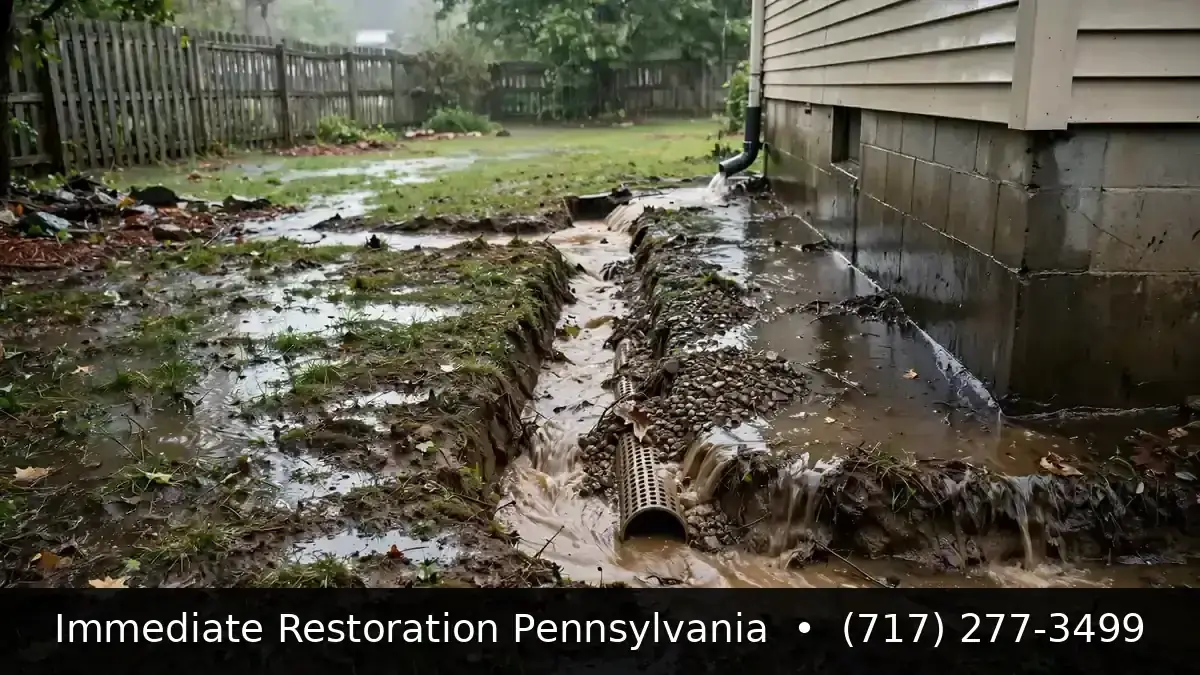
The ground under Squirrel Hill has a name: the Pittsburgh Red Beds. It's a clay-heavy geology that expands when wet, drains poorly, and holds moisture against foundations for days or weeks after a storm — maintaining hydrostatic pressure that pushes water through the smallest crack in a century-old basement wall. On September 3, 2026, 1.6 inches of rain fell on Squirrel Hill in thirty minutes, and stormwater runoff flooded basements and streets across the neighborhood. The big brick Victorians and foursquares along Murray Avenue — many built between 1895 and 1914 with full basements, slate roofs, and 13 rooms — are beautiful, and every one of them sits on clay that never fully lets go of the water. Immediate Restoration Pennsylvania provides 24/7 water damage restoration in North and South Squirrel Hill: extraction, structural drying, sewage cleanup, and mold remediation for the neighborhood's grand homes and its quieter streets alike.
Water Damage Services in Squirrel Hill
Clay, Buried Creeks, and Big Old Houses
Squirrel Hill's water problem is a three-layer stack. The base layer is the Red Beds clay: expansive, poorly drained soil that keeps foundations under pressure long after the rain stops. Efflorescence on basement masonry — the white mineral crust — is the visible signature of water being forced through the wall. The middle layer is another of Pittsburgh's buried creeks: the Four Mile Run watershed touches Squirrel Hill, a stream diverted underground a century ago into combined sewers. PWSA's stormwater project will restore a naturalized surface channel from Panther Hollow Lake in Schenley Park to the Monongahela, letting Squirrel Hill and Oakland rainwater reach the river without entering the combined sewer — but until then, the buried stream and the combined system share the same overloaded pipes. The top layer is the housing itself: two-and-a-half to three-story brick homes, four and five bedrooms, many with finished or walkout basements full of the things water ruins.
The September 2026 storm showed how the layers combine: half an hour of intense rain, clay that can't absorb it, sewers that can't carry it, and basements that take the result. And Squirrel Hill's position between Frick Park and Schenley Park means park-adjacent runoff adds to the load — the neighborhood's famous "Blue Slide" section of Frick Park sits just blocks from homes marketed on their park proximity.
Our Squirrel Hill Approach
- Water-path diagnosis — Seepage, sewer backup, buried-creek surge, or plumbing failure: we determine the path before prescribing the fix.
- Extraction — Standing water out of basements and lower levels.
- Clay-aware drying — Masonry and clay-soil-adjacent foundations need patient, verified drying. Daily readings; we stop when the meters say dry, not when the calendar says so.
- mold and sanitization — Antimicrobial treatment on every wet surface; full remediation where mold has established.
- Restoration and prevention — Rebuild finishes, and recommend the defenses that actually work on Red Beds: interior perimeter drainage, sump pumps with battery backup, exterior grading, and foundation sealing where appropriate.
Areas We Cover Around Squirrel Hill
South Squirrel Hill · North Squirrel Hill · Murray Avenue corridor · Forbes Avenue · Frick Park edge · Schenley Park edge · Greenfield border · Regent Square border · Point Breeze border
Nearby areas we serve: Pittsburgh, PA · Point Breeze, Pittsburgh · Polish Hill, Pittsburgh · Regent Square, Pittsburgh · Shadyside, Pittsburgh · Sheraden, Pittsburgh
Related guides: Pittsburgh Floods: The 1936 46-Foot St. Patrick’s Flood · Mold After Flooding: PA Basement Guide
Cost of Water Damage Restoration in Squirrel Hill
- Basement extraction and drying: roughly $2,500–$7,000
- Chronic seepage with mold remediation: roughly $3,000–$8,000
- Sewage backup with sanitizing: roughly $2,500–$8,000
Estimates confirmed by free inspection. Large older homes with extensive finished space may run higher; we price the actual scope.
Call Immediate Restoration Pennsylvania for 24/7 Emergency Service in Squirrel Hill
Clay, creeks, and old brick — Squirrel Hill basements need a crew that understands all three. Immediate Restoration Pennsylvania at (717) 277-3499 — 24/7 dispatch, free estimates, insurance-ready documentation.
Call (717) 277-3499 NowFrequently Asked Questions
What are the Pittsburgh Red Beds, and why do they flood my basement
A clay-heavy soil formation under much of western Pennsylvania. The clay expands when wet and drains very slowly, so after rain it holds water against your foundation for days, forcing it through cracks and porous masonry. It's the main reason Squirrel Hill basements seep even without a river nearby.
There's a white crust on my basement walls. What is it
Efflorescence — mineral salts left behind as water is forced through masonry. It's proof water is moving through your foundation walls, and it's usually accompanied by moisture that can feed mold. We can assess the extent and the fix.
My basement only floods in the worst storms. Do I still need a sump pump
Those "worst storms" are getting more frequent — the September 2026 event dropped 1.6 inches in 30 minutes. A sump pump with battery backup is inexpensive insurance against the next one.
Can you dry a finished basement without tearing everything out
Sometimes. We map moisture precisely; if water stayed low and materials dried quickly, targeted drying can save finishes. If drywall wicked water or sat wet, removal is the honest answer — we'll show you the readings.