# Water Damage Restoration in Beaver, PA
In February 1884, the Beaver River staged the worst flood in Beaver County history — the "Big Flood." The waters undermined the Fallston bridge, swept it down the Beaver River against the Rochester–West Bridgewater bridge, and both spans crashed into the Cleveland & Pittsburgh Railway bridge, partially demolishing the P&LE span. Residents along the Beaver and Ohio rivers fled to higher ground; at Baden the Ohio crept across the PRR tracks. A March 1832 flood had risen slightly higher but damaged less; the terrible 1913 flood, which drowned the whole valley from the Ohio River north — New Brighton, Fallston, and Beaver Falls suffered most — did not compare. Beaver, the county seat since 1800, sits near the confluence of the Beaver and Ohio Rivers, where the Beaver and Erie Canal had its southern terminus. The town has always lived at the water's edge — Fort McIntosh, erected in late 1778 by General Lachlan McIntosh as the first U.S. post north of the Ohio, stood between today's Insurance and Market Streets, its footprint markers still lining River Road. Immediate Restoration Pennsylvania provides 24/7 water damage restoration across Beaver: emergency water extraction, structural drying, sewage cleanup, and mold remediation for a county-seat borough where flood history is written into the street grid. One call gets a certified crew to your door.
The Confluence Town's Flood Record
Beaver's position near the Beaver–Ohio confluence means it takes water from two directions. The 1884 Big Flood remains the benchmark: the bridge-destroying sequence down the Beaver River into the Ohio is still the county's worst on record. The March 1913 flood rose through the entire valley. In August 1960, flash flooding put as much as three feet of water in Beaver Falls streets just across the river, flooding basements. A Rivers of Steel heritage study notes the last severe river flood was 1964 — and the April 2–4, 2024 regional event brought it back: Beaver County communities flooded, landslides hit Independence Township, and PennDOT restricted Route 51 in Fallston on April 12, 2024. Ohio River reference points: flood stage 22.0 feet at Pittsburgh, 25.0 at Dashields, 33.0 at Montgomery.
The borough's built history tracks the water. Laid out in 1792, Beaver's current Art Deco courthouse went up in 1933 after a fire; the 1859 county jail and 1912 Borough Hall anchor the historic district along Third Street and Quay Square. Fort McIntosh — abandoned in 1788, razed soon after, National Register-listed April 24, 1975 — reminds every River Road walker that this town's first structure guarded a river crossing.
Why the Borough Says You Own Your Lateral
Beaver's water and sewer provider is the Beaver Borough Municipal Authority — the borough established its own water works in 1886 and conveyed the system to the authority in 1967. The authority's customer pages carry one of the bluntest disclaimers in Pennsylvania: the property owner is responsible for the water line from the main to the premises and for the sanitary sewer service line from the main trunk to the premises, including street replacement. The authority warns it is generally not liable for sewer backups under governmental immunity, recommends installing backflow prevention devices, and notes that homeowners insurance normally doesn't cover sewer backup.
Read that as a water-damage professional reads it: in Beaver, a sewer backup is the homeowner's problem from the main to the house, and the standard policy won't pay for it. Backflow prevention — a check valve or backwater valve on the lateral — is the single most effective defense, and the authority itself recommends it.
Neighborhoods and Nearby Areas We Serve
Third Street commercial district · River Road · Quay Square · Insurance, Market & Bank Streets · Confluence bluff neighborhoods · Riverfront floodplain · Nearby: Bridgewater, Rochester, Beaver Falls, Fallston, New Brighton, Vanport
Nearby areas we serve: Ross Township, PA · Sewickley, PA · Shaler Township, PA · Uniontown, PA · Upper St. Clair, PA · Washington, PA
Related guides: Pittsburgh Floods: The 1936 46-Foot St. Patrick’s Flood · Cost of Water Damage Restoration in Pennsylvania
Water Damage Restoration Cost in Beaver
- Single-room clean-water cleanup: roughly $1,200–$2,500
- Basement extraction and drying: roughly $2,500–$7,000
- Sewage backup with sanitizing: roughly $2,500–$8,000
- mold remediation: roughly $2,000–$6,000+
Estimates — a free inspection confirms pricing. Backflow-device installation is quoted separately after inspection.
Our Water Damage Services in Beaver
Why Beaver Homeowners Choose Immediate Restoration Pennsylvania
- 24/7 emergency dispatch — Confluence floods don't wait for morning.
- Lateral-liability expertise — We know Beaver's "you own it" policy and document accordingly.
- Backflow-prevention guidance — We assess whether your home needs a backwater valve.
- Historic-district care — Older borough homes dried without damage to historic fabric.
Our Water Damage Restoration Process
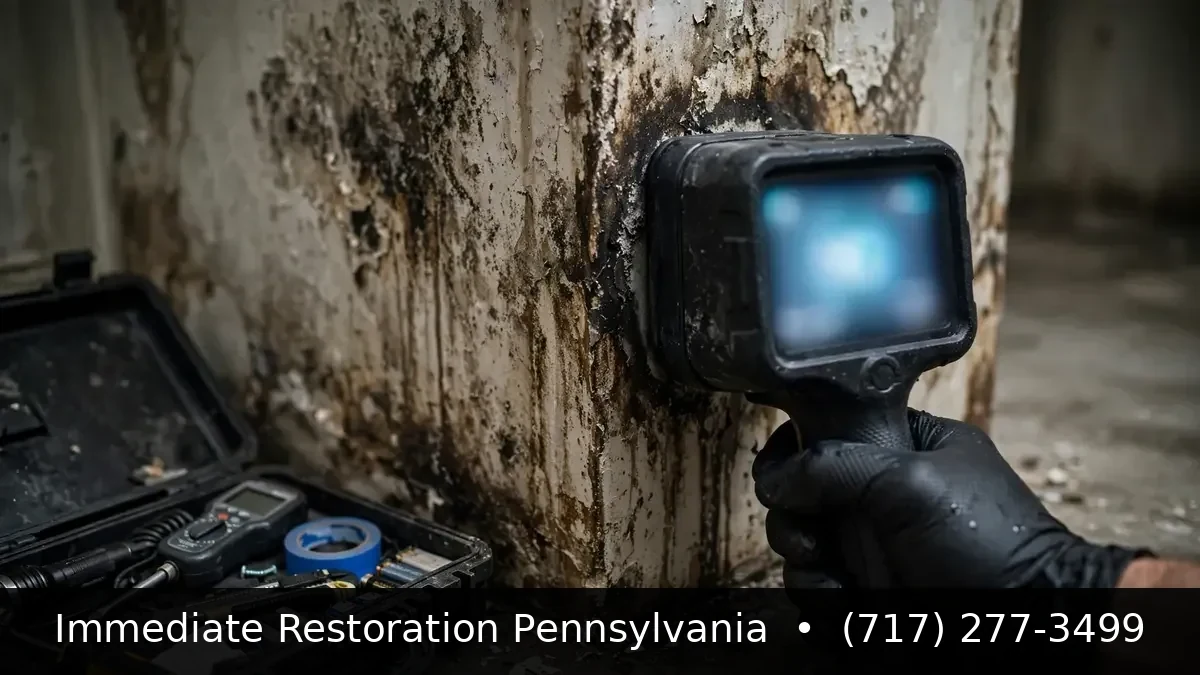
- Inspection and moisture mapping — Infrared and meters find water behind walls, under floors, and in foundations.
- Water extraction — Truck-mounted and portable extraction sized to the job.
- Structural drying — Air movers and dehumidifiers with daily verified readings.
- mold prevention — Antimicrobial treatment; full remediation where growth has started.
- Rebuild — Drywall, flooring, and finishes restored to pre-loss condition.
Commercial Water Damage in Beaver
Third Street businesses, county-seat offices, and riverfront commercial properties need fast turnaround. We provide priority response, after-hours mitigation, and business-interruption documentation.
Call Now for 24/7 Emergency Water Damage Service in Beaver
The county seat at the confluence, the 1884 Big Flood's bridge-wrecking record, and a water authority that says the lateral is yours — Beaver water damage gets worse by the hour. Immediate Restoration Pennsylvania at (717) 277-3499 — 24/7 dispatch across Beaver County, free estimates, insurance-ready documentation.
Call (717) 277-3499 NowFrequently Asked Questions
What was the 1884 "Big Flood"
The worst flood in Beaver County history, in February 1884: the Beaver River undermined the Fallston bridge, swept it into the Rochester–West Bridgewater bridge, and both spans crashed into the Cleveland & Pittsburgh Railway bridge.
Where was Fort McIntosh
Between today's Insurance and Market Streets in Beaver — built of hewn logs in late 1778 by General Lachlan McIntosh as the first U.S. post north of the Ohio River. Footprint markers survive along River Road.
Why does Beaver's water authority tell homeowners to install backflow devices
Because the authority is generally not liable for sewer backups under governmental immunity, and homeowners insurance normally doesn't cover them. A backflow prevention device on your lateral is the defense the authority itself recommends.
Who owns the sewer lateral in Beaver
You do. Per the Beaver Borough Municipal Authority, the property owner is responsible for the water line from the main to the premises and the sanitary sewer service line from the main trunk to the premises — including street replacement.
What was the southern terminus of the Beaver and Erie Canal
The Beaver River–Ohio River confluence near Beaver — about 20 miles downstream of Pittsburgh. The 136-mile canal with 137 locks was built 1831–44 and closed in 1872.
What is flood stage at Montgomery Dam
33.0 feet on the Ohio River (2026 NWS reference values; Pittsburgh 22.0, Dashields 25.0). The 1936 flood peaked at 53.2 feet at Montgomery — more than 21 feet over flood stage.