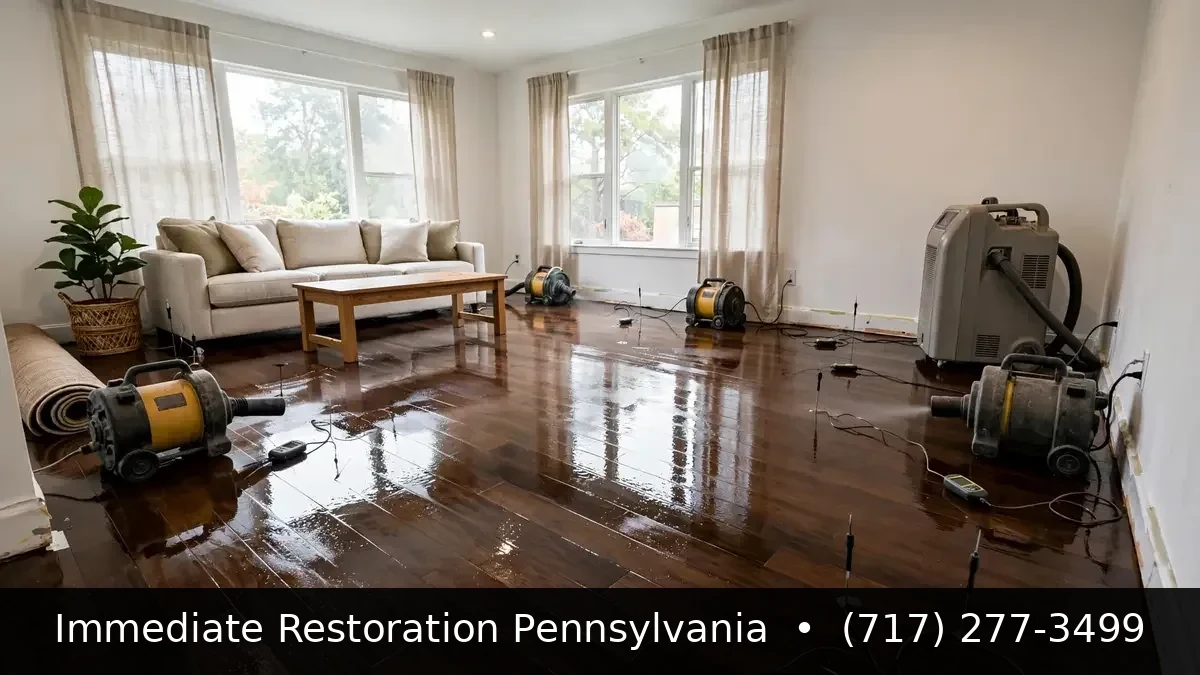
# Water Damage Restoration in Fairmount, Philadelphia
This is the neighborhood where Philadelphia first solved its water problem. The Fairmount Water Works went up in 1815 as the city's first pumping station — iron machinery in neoclassical buildings on the Schuylkill, filling a reservoir on the "Fair Mount" where the Art Museum now stands. It closed in 1909, became the Philadelphia Aquarium in 1911, then the Kelly Natatorium pool from 1962 until Agnes's 1972 flood damage shut it permanently. During Ida, the Schuylkill crested at 16.35 feet — just under the 17-foot historic record — and floodwater "blew out doors and windows" at the Water Works, destroyed the elevator and sprinkler system, and left about six inches of muck: the building's fifth flood since its 2003 museum reopening. Immediate Restoration Pennsylvania provides 24/7 water damage restoration across Fairmount: emergency extraction, Schuylkill flood cleanup, structural drying, and mold remediation.
Water Damage Services in Fairmount
Where Philadelphia First Solved Its Water Problem
The Water Works is the neighborhood's flood parable: a building that expected a 100-year flood and has flooded five times since 2003. The October 1869 flood — the worst Schuylkill flood ever recorded, the Fairmount Dam buried under 11-plus feet of water — set the historical ceiling; Agnes in 1972 ended the pool era; Ida in 2021 closed the center for six-plus months and pushed the planned "POOL: A Social History of Segregation" exhibit to World Water Day 2022. A February 2026 feature on the building's climate threat keeps the story current.
Above the river, the water story is the houses. Fairmount's homes were generally smaller working-class rows and town houses — built for the factory and brewery workers Baldwin Locomotive Works drew, which drove development south of Fairmount Avenue in the 1840s–60s. Fairmount Avenue divides this neighborhood from Spring Garden's grander stock. Nineteenth-century foundations, combined sewers, and basement seepage are the norm; the plateau sits on the old "Fair Mount," elevated above the river — so river flooding of Fairmount homes is not the documented risk. The documented risks are the ones every old rowhouse neighborhood shares: cloudburst backups, aging plumbing, main breaks.
Eastern State Penitentiary at 2027 Fairmount Avenue — opened 1829, John Haviland's hub-and-spoke design, the first prison built to reform rather than punish, the model for 300-plus prisons worldwide, operating until 1971, now a National Historic Landmark museum. Nearby Girard College (1831), funded by Stephen Girard's will, with Founders Hall as an early Greek Revival landmark.
Our Fairmount Response
- River-flood cleanup — Schuylkill water carries sediment and contamination. We extract, remove debris and muck, and sanitize everything the river touched.
- Historic-rowhouse drying — Smaller 19th-century working-class houses, old foundations, plaster walls. Verified drying with daily meter readings.
- Basement and plumbing response — Cloudburst backups and aging-pipe failures get fast extraction before mold starts.
- Mold prevention and remediation — In 150-plus-year-old houses, mold starts in 24–48 hours. We treat to prevent and remediate when it's established.
- Commercial and institutional service — Museum-corridor neighbors, restaurants, and shops get after-hours mitigation to protect inventory and limit closures.
Areas We Cover Around Fairmount
Spring Garden · Francisville · Brewerytown · Logan Square · Fairmount Park · Art Museum area · Callowhill · Sharswood
Nearby areas we serve: Philadelphia, PA · Brewerytown, Philadelphia · Bridesburg, Philadelphia · Bustleton, Philadelphia · Callowhill, Philadelphia · Center City, Philadelphia
Related guides: Hurricane Ida’s Philly Flooding: Lessons for Homeowners · Cost of Water Damage Restoration in Pennsylvania
Cost of Water Damage Restoration in Fairmount
- Basement extraction and drying: roughly $2,500–$7,000
- River-flood cleanup with sanitizing: roughly $3,000–$9,000
- Plumbing-failure response: roughly $1,500–$5,000
Free estimates; insurance-ready documentation on every job.
Call Immediate Restoration Pennsylvania for 24/7 Emergency Service in Fairmount
The city solved its water problem here in 1815 — and has been re-solving it ever since. When water reaches your home, Immediate Restoration Pennsylvania at (717) 277-3499 — 24/7 dispatch, free estimates.
Call (717) 277-3499 NowFrequently Asked Questions
What happened to the Fairmount Water Works during Ida
The Schuylkill crested at 16.35 feet, and floodwater blew out the Water Works' doors and windows, destroyed its elevator and sprinkler system, and left about six inches of muck — closing the center for six-plus months. The building's fifth flood since its 2003 reopening, after planning for a 100-year flood. If a 200-year-old landmark floods five times in two decades, your basement's odds aren't better.
What did Hurricane Agnes do to the Water Works
Agnes's 1972 flooding ended the Kelly Natatorium era permanently — the pool had operated in the old Water Works buildings from 1962. The neighborhood's reminder that Schuylkill floods don't just damage buildings; they end uses.
My rowhouse is 150 years old. Can you dry plaster walls without destroying them
Yes — with patience. Nineteenth-century plaster on lath holds water and crumbles if dried too aggressively. We use controlled dehumidification, monitor with moisture meters, and remove only plaster that's lost its bond.
Is Fairmount's hill enough to protect it from river flooding
For the plateau homes, largely yes — the core sits on elevated ground with no documented pattern of river flooding reaching homes. But elevation doesn't stop cloudburst sewer backups, aging plumbing, or main breaks. The hill handles the river; it doesn't handle the pipes.