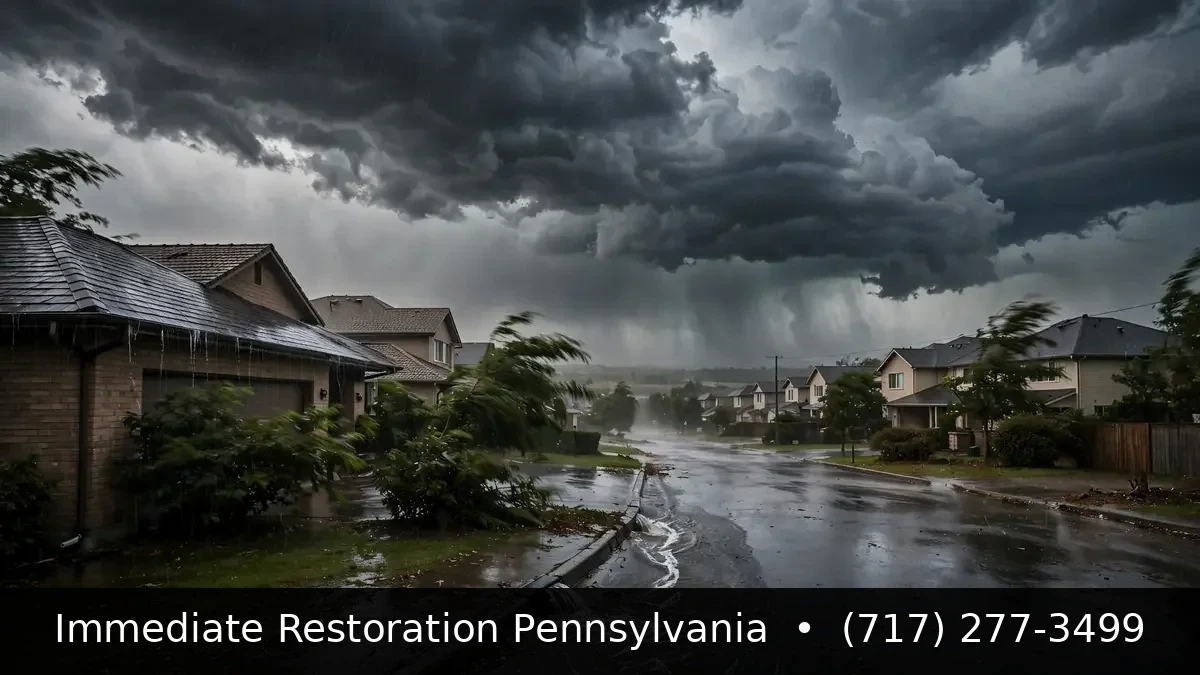
# Water Damage Restoration on Mt. Washington, Pittsburgh
The hill that slides the most gets the best view. Mt. Washington's Grandview Avenue overlook and its two working inclines — the Monongahela Incline from 1870 and the Duquesne Incline from 1877, both on the National Register and both recognized as Historic Mechanical Engineering Landmarks — draw visitors to one of America's great urban vistas. The Planning Department called the north slope "one of the most unstable hillside areas in the city" — a 1971 Pitt study found Grandview's landslide frequency higher than any comparable area in the country, with 12 failures in 30 years. On Mt. Washington, the enemy isn't river water. It's hillside water. Immediate Restoration Pennsylvania provides 24/7 water damage restoration on Mt. Washington: emergency extraction, hillside-runoff drying, sewage cleanup, and mold remediation.
Water Damage Services on Mt. Washington
A Century of Slides, From 1933 to 2024
University of Pittsburgh photos document a slide on William Street in 1933. In February 2018, a hillside section collapsed below Emeraldview Park and buried a home in Ingram at the mountain's edge — residents had been evacuated two days before, and sued in 2019 alleging runoff from Emeraldview fed the slide. In May 2024, work began on a new William Street slide as part of a roughly $10 million FEMA-funded remediation; the city later celebrated completing three sites — Greenleaf, Reese, and William streets — with soil nails, caisson walls, rock buttresses, and drainage improvements. In September 2024, the P.J. McArdle Roadway closed for five days so crews could remove slide-prone debris; Saw Mill Run drains the mountain's western base along Route 51.
For homeowners, the geology is the daily problem: steep slopes shed stormwater into foundations, clay and Red Bed soils hold water against the house, and older combined sewers surcharge in cloudbursts. The early-1900s hillside houses have drainage-dependent foundations — when the hill moves water, the basement gets it. Even the inclines felt it: in 2026, two people were rescued by high-angle rope rescue from stalled Monongahela Incline cars.
Our Mt. Washington Water Response
- Hillside-source triage — Runoff, spring water, sewer surcharge, or a broken pipe: we trace the water's path before extraction, because hillside homes flood from uphill.
- Fast extraction — Standing water out of basements and lower levels, including homes where the water arrived through the foundation wall itself.
- Verified drying for hillside construction — Clay soils keep feeding moisture to foundations after the storm passes. We meter walls and slabs daily until readings confirm genuine dry.
- Mold and sanitation — Persistent dampness is the Mt. Washington specialty. Antimicrobial treatment standard; full remediation where growth has established.
- Drainage-hardening advice — Exterior grading, foundation drainage, sump pumps with battery backup, and sealed entries — the defenses that keep the hillside outside.
Cost of Water Damage Restoration on Mt. Washington
- Hillside-runoff basement extraction and drying: roughly $2,500–$8,000
- Foundation-seep cleanup: roughly $1,500–$5,000
- Mold remediation after chronic dampness: roughly $2,000–$8,000
Free inspection confirms every estimate. Hillside homes often need longer drying — we price the moisture, not the clock.
Areas We Cover Around Mt. Washington
Grandview Avenue · Duquesne Incline · Monongahela Incline · William Street · Warrington Avenue · P.J. McArdle Roadway · Emeraldview Park · Saw Mill Run Blvd
Nearby areas we serve: Pittsburgh, PA · South Side Flats, Pittsburgh · Squirrel Hill, Pittsburgh · the Strip District, Pittsburgh · Troy Hill, Pittsburgh · Pittsburgh's West End
Related guides: Pittsburgh Floods: The 1936 46-Foot St. Patrick’s Flood · Sump Pump Failure and Basement Flooding in PA
Call Immediate Restoration Pennsylvania for 24/7 Emergency Service on Mt. Washington
The best view in Pittsburgh comes with the city's most restless hillside. Immediate Restoration Pennsylvania at (717) 277-3499 — 24/7 dispatch, free estimates, insurance-ready documentation.
Call (717) 277-3499 NowFrequently Asked Questions
Why does Mt. Washington get so many landslides
Geology and grade. The north slope's soils and Red Bed clay sit on one of the city's steepest, most unstable hillsides — the Planning Department's phrase, backed by 12 documented failures in 30 years and a 1971 finding that Grandview's slide frequency topped any comparable area in the country. Water is the trigger: saturated slopes move, and stormwater from above feeds every slide.
Can hillside runoff flood my home if I live at the top of the hill
Yes — water flows downhill, and through soil. Homes at the top shed water onto homes below, but springs, saturated clay, and failed drainage can push water into any foundation on the slope. The 2018 Greenleaf slide started above homes, not below them.
What should I do if water is seeping from the hillside into my foundation
Act on the path, not just the puddle. Photograph the seepage, check whether it's active only after rain or constant (constant suggests a spring or broken pipe), and call us — we trace the source with moisture meters, extract and dry the interior, and advise on exterior drainage fixes that actually stop hillside water.
How did the 2024 remediation work change the slope risk
The roughly $10 million FEMA-funded project stabilized Greenleaf, Reese, and William streets with soil nails, caisson walls, rock buttresses, and drainage improvements — completed around early 2026. It reduces slide risk at those sites; it doesn't repeal the geology.